Plastics industry urgently needs more technicians and to contain youth migration
Plastics manufacturing companies are facing difficulties in recruiting young technical staff. Migration and staff turnover are some of the main challenges. Experts agree that it is necessary to improve the training of young people in order to meet the sector’s demand.
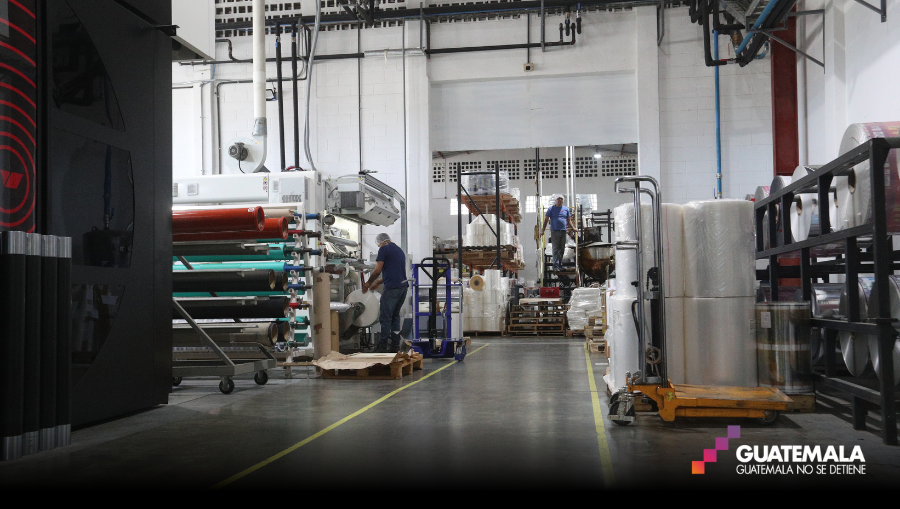
A plastic products factory in Amatitlán manufactures packaging and everyday items such as plastic bags, food packaging, and beverage labels. The process begins with the purchase of polyethylene—an imported raw material—which is then mixed to define the properties of the plastic. The mixture passes through extruders, where it is melted and transformed into sheets or structures. The final product is then printed, cut, and sealed. Technical personnel are involved in each phase, operating and supervising the machines.
According to the 2024 Employer Report, the plastics industry in the country generated around 17,557 jobs. Of these, 80% are held by men and 20% by women. Forty-seven point two percent of workers are plant, machine, and assembly operators; 15.4% are administrative support staff; and 10.5% are technicians and intermediate professionals. The report also details that 67.8% of employees have completed middle school education, 14.3% have high school education, and 6.5% have university education.
However, one of the challenges facing the industry is related to staff turnover and the effects of migration. Olga Orellana, president of the national plastics sector, indicated that generational change has influenced worker retention in companies. “Generational change is giving us a slightly more restless workforce, who do not stay in their jobs for long and then look for something different,” she explained.
She added that migration has also impacted the availability of workers, especially since the start of the pandemic. “It was quite a difficult issue to deal with. Many people who were valuable to our companies, because of all their knowledge, chose to leave in search of other horizons,” she said.
The Director of Statistics at the Ministry of Labor, Julio Hernández, explained that migration affects different economic sectors, particularly industry, due to the specialization required of its workers. “Several companies mentioned that it was costly to train people who would subsequently leave, resulting in high turnover in these positions and burdensome training costs for some companies,” he said.
He adds that the sector requires more specific academic training. “This requires training in the operation of specialized machinery used in this industry,” he said.
Hernández indicated that the sector has shown growth in the number of employees in recent years. In 2023, the industry employed around 16,300 people, and in 2024, it generated 1,257 new jobs. Between 2014 and 2015, the sector’s economic activity growth rates ranged between 14% and 16%. Subsequently, between 2016 and 2018, growth was between 3.1% and 3.4%.
Orellana stated that this industry serves a wide variety of markets. “We are serving around 92% of the economic activities identified by the Tax Administration Superintendence (SAT) [for its acronym in Spanish],” she said.
She added that the sector has increased its share of exports. “In 2024, we generated exports equivalent to 4% of the national total, and in 2025 we reached 5%.” She also highlighted that jobs tend to be long-term. “Each job generated by the sector is generally permanent and not temporary,” she explained. According to Orellana, the industry pays around Q2.5 billion annually in salaries
Advance in the industry
According to Marcos Arimany, vice president of the Plastics Guild, the sector has undergone significant technological transformations in recent decades. “I would say that in about 20 years, the industry has changed enormously in terms of technology,” he said.
He pointed out that current processes are more automated and accurate. “In the past, machines operated with buttons, switches, and a few sensors. Today, systems are more computerized and have more precise controls.”
According to a recent study on talent gaps conducted by the Fundación para el Desarrollo (Fundesa) [for its acronym in Spanish], 76% of staff in this sector are concentrated in operational roles, 19% in technical or administrative positions, and 5% in management positions.
Arimany warned that these technological advances require greater investment and more highly trained staff. “The investment value is higher because these are more sophisticated systems, which require personnel with new skills.”
Orellana agreed that the industry is moving toward more innovative processes. “We are a highly innovative sector that requires large investments in machinery, technology, and, therefore, technical labor.”
More trained personnel
One of the main challenges facing companies that manufacture plastic products in the country is finding personnel with specialized technical knowledge. Orellana explained that many companies have to train their workers from the moment they join the company. “The workforce we need is quite technical, and we don’t usually find it on the market,” she said.
She added that companies implement structured training processes to develop the skills required by the industry. “Many companies have an onboard process, but the two-month trial period established by law is not usually enough for the person to master all the necessary skills,” he said.
The training process often represents high costs for contracting companies. “It’s an investment we have to make because it’s impossible to find workers with sufficiently developed skills to say that we are hiring people who are already trained,” she explained.
Arimany indicated that experience and technical training influence training times. “We have to train someone internally and help them progress within our processes. If someone comes in without specific training, the learning curve exceeds six months, and turning them into an expert can take more than a year,” he explained.
He added that hiring processes can also be lengthy. “We have had cases where a hiring process has taken up to three months. The costs of training and developing skilled personnel are high, especially given the time it takes,” he said.
According to Arimany, job mobility between companies in the sector is common. “Normally, what happens is that people rotate between the same companies. It is rare for someone new to join the operational cycle. The fact is that there are a limited number of companies in the industry and a similar number of people who have mastered these processes,” he said.
Migration and job turnover
Hernández added that labor shortages also affect job mobility within the sector. He pointed out that when workers gain experience and training, they can receive better job offers. “Many people can move to another position, either with better pay or better working conditions,” he explained.
According to the talent gap study, 64% of companies use personal recommendations or networking as their primary recruitment mechanism; 21% use job portals and 15% use internal databases or job fairs.
For Arimany, the availability of skilled labor has become more limited in recent years. “Migration was a serious problem in previous years, and staff turnover has also been on the rise,” he said. He added that the departure of workers has been a challenge for companies due to the time needed to train new employees.
From the private sector, Ricardo Rodríguez, manager of the Macroeconomic Division at Central American Business Intelligence (Cabi), pointed out that migration patterns have changed in recent years. Between 2020 and 2024, there was an increase in migration to the United States, while in 2025 the figures reflect a decrease in attempts to cross the border. “The figures show 90% fewer arrests at border points in the southern United States, indicating that fewer people are attempting to cross the border,” he said.
The representative added that this context could influence the decision to migrate. “Today there is a disincentive to migrate, because the immigration situation in the United States is more complex. That could help prevent new migrations,” he said.
More technicians are needed
The plastics industry reports difficulties in filling specialized operational positions and middle management roles. According to Orellana, these levels pose the greatest hiring risks. “The biggest problem is at the operational level. There are fairly simple and repetitive processes that do not present any major difficulties, but there are also more specialized processes,” he explained.
He added that supervisors need both technical skills and the ability to manage staff, without necessarily reaching engineering levels. “These intermediate positions are the ones that take a little more effort to develop,” he said.
Orellana also pointed out that there are gaps in basic knowledge when workers enter the sector. Among them, he mentioned the handling of simple calculations, percentages, measurements, and weight equivalencies. “These are fairly basic aspects of general knowledge,” he said, while also highlighting the need for training in the technological use of machinery.
Arimany, representative of the industrial sector, indicated that production processes have incorporated technological developments that require new skills. “Specific training for each process is very important, but we have moved toward technologies where electronics are increasingly relevant,” he said.
According to Arimany, operators must adapt to more automated and sophisticated systems. “We are leaving behind many mechanical and manual processes in favor of more precise controls, and that is where the opportunity lies,” he said.
The businessman indicated that the industry requires both engineers and technical personnel, although he emphasized that the greatest demand is concentrated in the latter group. “I would think that the technical area is more important, because we need more people. They are the ones that take care of business at the machine and in charge of day-to-day operations. That is where we must focus more of our efforts,” he explained.
Lack of interest among young people
Representatives from the academic community and technical training point out that, despite labor demand, there is low participation among young people interested in careers related to manufacturing and the plastics industry.
Ingrid de León, Director of Industrial Engineering at the Universidad del Valle de Guatemala (UVG), indicated that the country has professionals capable of assuming leadership roles in industry, although she considers that the number is insufficient given the growth of the sector. “There are leaders, but the potential we have in industry is very great and we are falling short,” she said.
She explained that business demand for students in these areas has increased in recent years, especially in engineering-related careers. “In the third, fourth, and fifth years, we see companies requesting students from us, and sometimes we have to tell them, ‘I don’t have any left.’ The students who can be placed are already placed,” she said.
According to the academic, the industry requires both technical personnel and specialized professionals for its development. “You need technical labor that allows you to operate from a day-to-day perspective, but you also need specialists who bring new technology,” she explained. She added that the sector’s development depends on a combination of both profiles.
Young people are becoming less interested in jobs in the manufacturing industry and prefer to work in other sectors. (Photo Prensa Libre: Erick Ávila).
De León pointed out that one of the main difficulties is the low number of young people choosing to study engineering-related degrees. “We need young people to want to study engineering, to not be afraid of it. It’s a degree that allows you to develop many skills and make a difference,” he said.
In the case of technical training, the Instituto Técnico de Capacitación (Intecap) [for its acronym in Spanish] has also identified limitations in student participation. Martha Pozuelos, manager of the Division, pointed out that specific programs for the plastics industry have been promoted, although some have been suspended due to a lack of enrollment. “We have had specific programs for the plastics industry, but they had to be closed at some point because there was no interest in participating in this type of training,” they said.
Educational changes
Pozuelos explained that Intecap works with industry through standardized training programs. “We collaborate with the plastics industry in different ways. We have generalized programs that are taught nationwide, where we define, through professional profiles, the specific positions in which people can find employment,” he said.
The Ministry of Labor also has programs aimed at job placement. Julio César, a representative of that ministry, explained that one of them is Beca Mi Primer Empleo [My First Job Scholarship], aimed at young people seeking to gain experience. “This program seeks to give young people the opportunity to gain work experience. The Ministry absorbs 51% of the labor cost, and the rest is covered by the company,” he said.
The official added that, since 2025, the Labor Demand Survey has been implemented, which has made it possible to identify the positions considered key within the plastics subsector. “The companies mentioned managers, production operators, and purchasing staff as the main positions,” he said.
According to Arimany, the country faces a major challenge in terms of education. “Starting in elementary school, there is a gap in the education of our youth. Not to mention what comes next: technical training is very scarce. We should start from the ground up to prepare and train our people from the most basic levels so that they can develop technical skills,” he said.
Orellana also indicated that education needs to be geared toward more technical content. “As a society, we need to shift toward a more technical curriculum. There is content that is not functional when it comes to entering the workforce,” he said.
Meanwhile, Arimany pointed out that technical training faces limitations at basic educational levels and that industrial processes in the sector require specialized knowledge.
He added that coordination between educational centers, technical institutions, and companies is an important factor in aligning training with the needs of the productive sector.
Find more of Guatemala Moving Forward on our Prensa Libre and Guatevisión video channels, content produced in partnership and focused on solutions journalism.