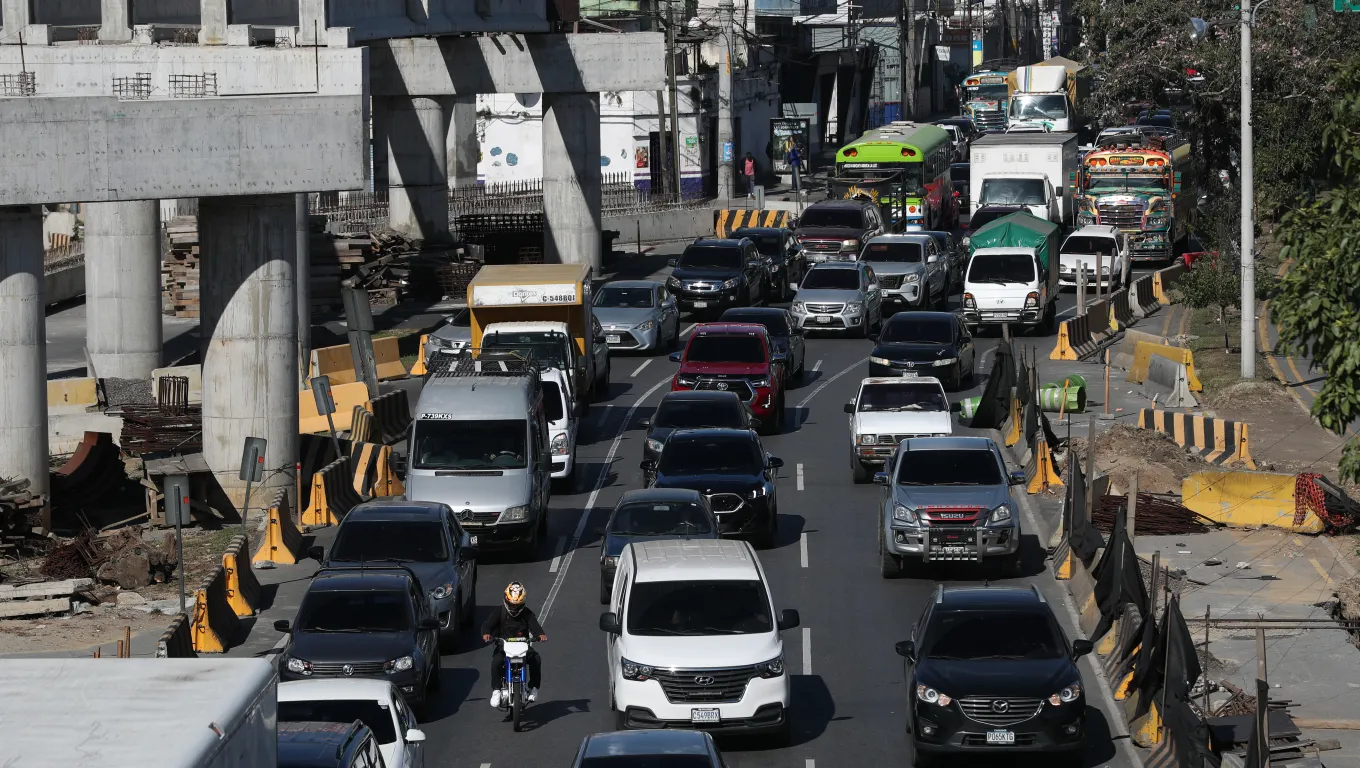
Every Guatemalan loses 54 days a year in traffic: what are the solutions?
Traffic congestion generates economic losses amounting to Q1,300 per person. Experts point to the need to improve existing infrastructure, mass transit, and urban planning to reduce daily commutes to the capital city.
Guatemala loses around Q1,300 per month in productivity for each member of the working population due to traffic congestion. According to Jorge Benavides, a researcher associated with the Fundación para el Desarrollo de Guatemala (Fundesa), when limiting the analysis solely to the department of Guatemala—with approximately 2.7 million employed people—these losses represent 9.4% of the department’s gross domestic product (GDP).
According to data from the Inter-American Development Bank (IDB), around 1,300 hours—equivalent to more than 54 days per year—are lost in traffic in Guatemala City, representing more than Q25 billion in economic costs. The department grew by 10.9% in 2023, according to the latest figures published by the Bank of Guatemala, and accounts for 43.3% of the total Guatemalan economy.
The phenomenon is related to the growth of the metropolitan area, which covers 44 suburban municipalities where at least five million people interact. “Today we are talking about journeys from Sanarate, Chimaltenango, Palín, Escuintla, and Oratorio, in Santa Rosa, which concentrate travel to the city. Today, this entire area, converging toward the heart of the country, is one of the main reasons why we have this traffic,” he said.
Data presented by Fundesa on Tuesday, based on records from the National Civil Police (PNC), indicate that in 2025 there were 8,864 traffic incidents, resulting in 2,428 deaths and 9,602 injuries, equivalent to a daily average of seven deaths and 27 injuries in traffic accidents.
The vehicle population has also grown steadily. There are currently around 6.4 million vehicles on the road in the country, with an average annual growth rate of 9.6% over the last two decades, while the road network has grown at a rate of 1.4% per year, equivalent to 1.07 meters of road per inhabitant. “Very few of us would fit side by side if we stood on the entire road network,” he explained.
Within the vehicle population, the growth in motorcycles stands out, reaching 3.2 million, a figure that represents 3.4 times the number of cars. In 2025 alone, the number of motorcycles grew by 15%, and in the last 20 years, the number of these vehicles traveling per kilometer of road network has increased tenfold.
“In 20 years, we have ten times more motorcycles per kilometer of road network. That explains part of the stress generated during rush hour due to the constant evasion and collisions involving motorcycles,” said Benavides.
Solutions
Benavides indicated that traffic congestion is caused by multiple factors, which is why he pointed out that addressing it requires different lines of action, focused on optimizing the current system, expanding infrastructure, strengthening mass transit, and promoting an urban model that integrates housing and services. “We have to avoid single-cause analysis. It is such a complex problem that looking for a single cause is an oversimplification. In reality, we are facing multiple causes that make the problem even more complex,” he explained.
One of the proposals consists of improving the management of the existing road system through minor interventions aimed at streamlining vehicular traffic, strengthening pedestrian mobility, reducing road intersections, and improving signage and road safety. “Streamlining traffic is definitely the way forward. We must also promote pedestrian mobility and ensure that those who travel on foot can do so safely,” he added.
Another line of work involves developing new infrastructure to connect strategic points in the metropolitan area. “Guatemala needs infrastructure that connects points that need to be connected. It’s not just a matter of widening streets or building overpasses, but rather completing the infrastructure that will enable the necessary mobility,” he said.
The projects mentioned include five radial routes, three ring roads, the Belice II bridge, the El Frutal bridge, the C-50 regional ring road, the Nororiente Expressway, and the Arco Norte Metropolitano.
He also raised the need to implement a multimodal mass transit system that includes the expansion of the Transmetro, the strengthening of the Transurbano and TuBus routes, as well as projects such as the Aerómetro and the development of a metro system, whose planning includes a 20.5-kilometer line with 22 stations and complementary works.
Benavides also highlighted the importance of coordinating housing policies with sources of employment and services to reduce daily commutes. “The basis of any development model is to ensure that people can live in a place where they have work, education, and services nearby. This reduces long commutes,” he said.
Increase in revenue for the city
Comparative data on the main access routes to the metropolitan area show an increase in vehicle volume over the last decade:
CA-09 Norte
- 2015: 38,840 vehicles circulated daily. 20.8% were heavy vehicles.
- 2025: 92,583 vehicles circulate daily. An increase of 138.4% compared to 2015.
CA-09 Sur
- 2015: 91,140 vehicles circulated daily. 17.4% were heavy transport.
2025: 226,934 vehicles circulate daily. An increase of 149% compared to 2015.
CA-01 Occidente
- 2015: 52,393 vehicles circulated daily. 12.4% were heavy transport.
- 2025: 193,589 vehicles circulate daily. An increase of 269.5% compared to 2015.
CA-01 Oriente
- 2015: 105,571 vehicles circulated daily. 5.5% were heavy transport.
- 2025: 308,214 vehicles circulate daily. An increase of 191.9% compared to 2015.
Travel times recorded in 2015
- Palencia – Guatemala City: 30 km, approximately 3 hours.
- San José Pinula – Guatemala City: 25 km, approximately 2 hours.
- Villa Nueva – Guatemala City: 21 km, approximately 2 hours and 30 minutes.
- Chimaltenango – Guatemala City, 58 km: approximately 3 hours.